

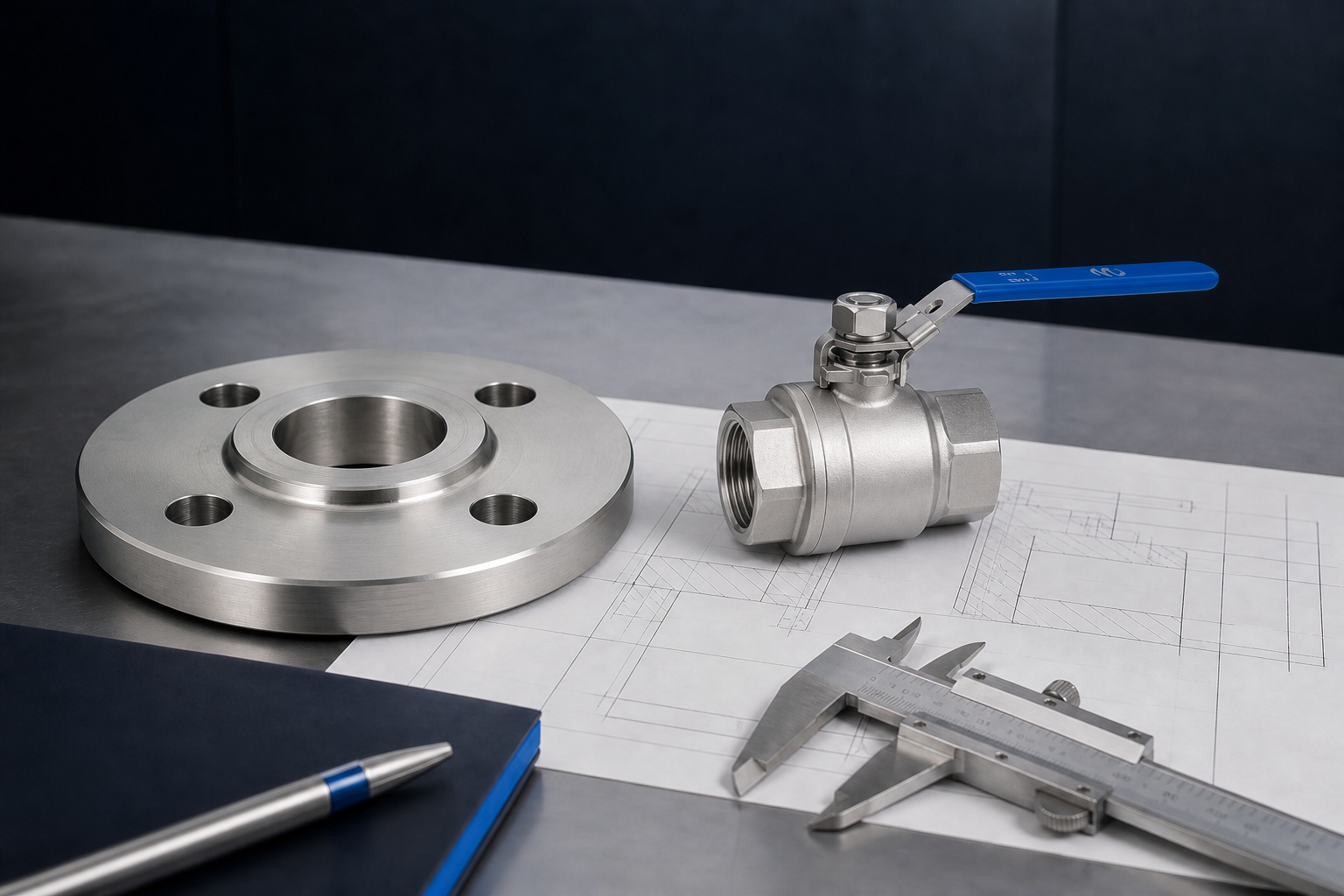
A request may use the correct product name and still be incomplete. “Four-inch valve,” “carbon steel pipe,” or “Class 150 flange” identifies a family, but not necessarily the item that will perform in the actual system.
A useful specification connects the product to its service. It should let the buyer, supplier, and manufacturer understand the same requirement, identify missing information, and compare offers on a common basis.
This article is informational. Final selection must be checked against design conditions, applicable requirements, and the project’s technical documentation.
1. Start with the application, not the product name
Before requesting a part number, document:
- the fluid or medium;
- the component’s function;
- location and environmental conditions;
- normal operation, startup, shutdown, and possible transients;
- regulatory or end-user requirements.
This prevents selection by visual similarity or by copying a previous purchase that served different conditions.
2. Define pressure and temperature together
A pressure designation by itself is not enough. Allowable capability may change with temperature, material, and component design. For thermoplastics, temperature and chemical compatibility are also mandatory selection criteria.
Record at least:
- normal and maximum design pressure;
- normal, minimum, and maximum temperature;
- vacuum, pulsation, surge, or other transient conditions when applicable;
- the approved source of these values.
Do not turn a class, schedule, or advertised pressure into an automatic service guarantee. Check the applicable standard and the selected product data sheet.
3. Separate material, grade, and wetted components
“Stainless steel” or “PVC” may be too broad. Identify the material and grade where applicable. For valves and assemblies, consider the body, trim, seat, seal, packing, and every component exposed to the medium.
Compatibility assessment requires the medium, concentration, temperature, and exposure conditions. A generic chart can guide a review, but it does not replace manufacturer validation for the specific item and service.
4. State the standard, edition, and scope
A standard may govern material, dimensions, design, testing, marking, or a combination of these. ASME B16.5, for example, covers pressure-temperature ratings, materials, dimensions, tolerances, marking, and testing for pipe flanges and flanged fittings within its scope. Merely writing “ASME” without a number and edition does not define the purchase.
The RFQ should include:
- standards body and complete designation;
- required edition or year;
- applicable grade, type, class, or category;
- supplementary requirements;
- related dimensional standard where needed.
If the project does not define the edition, leave it as an explicit question instead of making a silent assumption.
5. Complete dimensions, ends, and joint compatibility
Include nominal size, thickness or schedule, length, critical tolerances, and unit system. Specify threaded, socket-weld, butt-weld, flanged, grooved, solvent-cement, or other ends, plus facing, thread, or end preparation when relevant.
Do not combine SI and inch-pound values as if they were always exact equivalents. Some standards require the two systems to be used independently.
6. Define testing, inspection, and documents before quotation
A late documentation requirement can change price, lead time, or the eligible manufacturer. State from the beginning:
- required material certificate or test report;
- heat, lot, or serial traceability;
- dimensional or visual inspection;
- hydrostatic, pneumatic, nondestructive, or functional testing when applicable;
- certificate of conformity;
- document language, format, and delivery point;
- third-party inspection when contractually required.
“Complete certificates” is not a precise requirement unless the expected documents are named.
7. Control quantity, packing, and logistics
Every quantity needs a unit of measure. Define acceptable lot splits, spares, packing, end protection, marking, package limits, and destination. In international sourcing, these details affect consolidation, handling, and receipt.
Do not use an Incoterm as a substitute for the logistics specification. State the named place, Incoterms version, document scope, and operational responsibilities.
Minimum technical RFQ checklist
- Product and function.
- Fluid and application.
- Design pressure and temperature.
- Material and grade.
- Standard and edition.
- Size, thickness, class, or schedule.
- Ends and dimensional compatibility.
- Wetted parts, seals, and seats.
- Tests, inspection, and documents.
- Quantity, unit, packing, and delivery.
- Missing data stated explicitly.
- Revision control.
Common mistake: comparing prices before normalizing scope
Two quotations may look equivalent while covering different materials, editions, tests, or documents. Before comparing price, build a deviation matrix: compliant, proposed alternative, exception, and open point. A cheaper offer is not comparable if it excludes an essential requirement.
Closing
A strong specification does not try to predict every possible detail. It makes the selection criteria visible and records differences. That discipline reduces rework and supports a technically coherent comparison.
Do you have an incomplete list or several offers that are difficult to compare?
Let’s review your specification.Sources
- HexMetal Product Taxonomy v2.1, internal source reviewed 2026-08-27.
- ASME B16.5-2025 — Pipe Flanges and Flanged Fittings, accessed 2026-08-27: https://www.asme.org/codes-standards/find-codes-standards/b16-5-pipe-flanges-flanged-fittings-nps-1-2-nps-24-metric-inch-standard/2025
- ASTM A106/A106M-26 — Seamless Carbon Steel Pipe for High-Temperature Service, accessed 2026-08-27: https://store.astm.org/a0106_a0106m-26.html